
How to Plan a Safe Pool Party for Kids
A great kids' pool party is planned around the water, not the cake. Here's the exact playbook — ratios, layers, rules, and the gaps a professional is trained to catch.
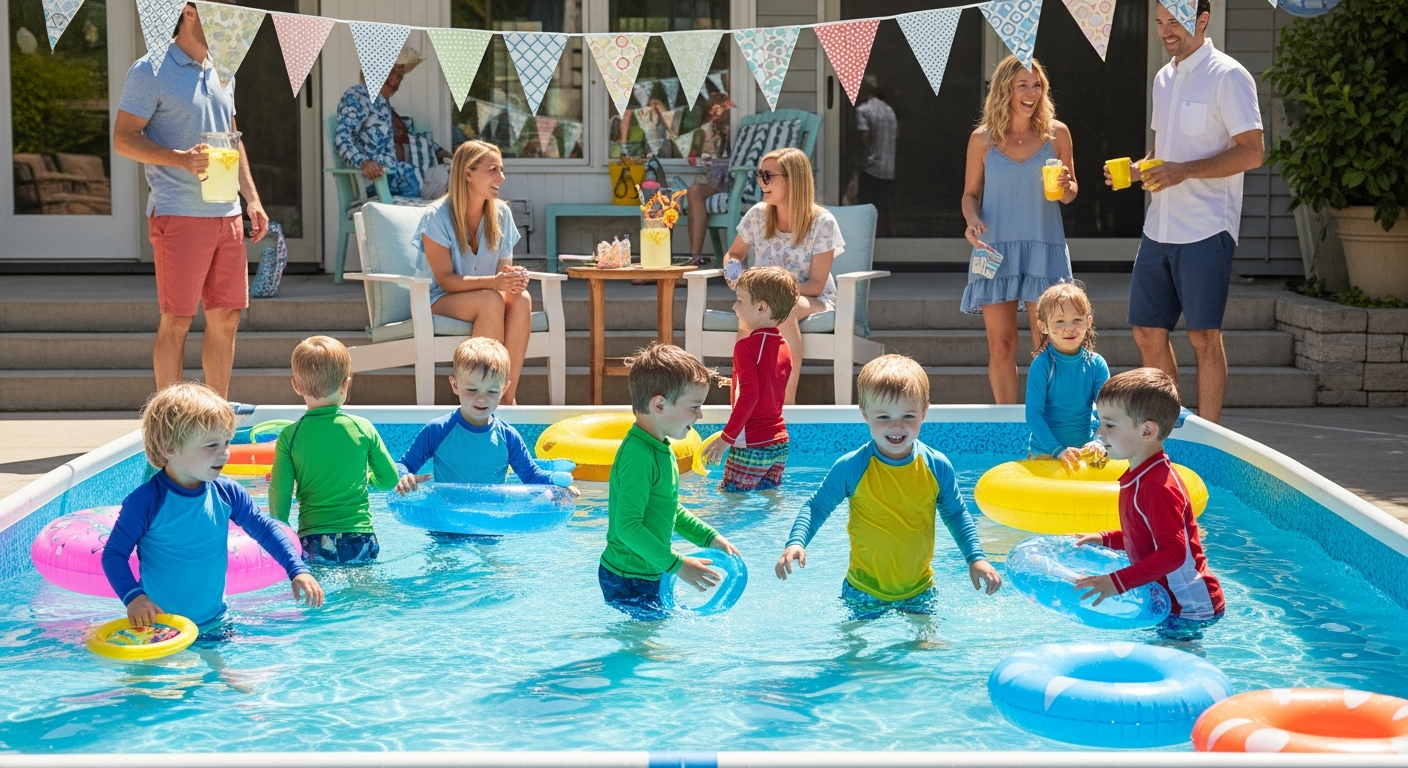
Start with the number that matters: supervision ratios
Drowning is the leading cause of death for children ages 1 to 4 in the United States, according to the CDC, and for ages 5 to 14 it remains one of the leading causes of unintentional-injury death. A kids' pool party concentrates exactly the age group most at risk into the exact environment where it happens — so the planning has to start with supervision, not snacks.
Ratios are the foundation. Professional facilities commonly staff one guard per 25 swimmers, but that assumes trained scanning and a controlled environment. For a mixed-age children's party, a safer working benchmark is one dedicated adult watcher per 8 to 10 kids in or near the water, and closer to one-to-one for toddlers and non-swimmers.
The mistake hosts make is counting adults present rather than adults assigned. Ten parents at a party is not ten watchers — it is usually zero, because everyone assumes someone else has it. Ratios only count people who have explicitly been given the job.
Assign a Water Watcher before anyone gets wet
The single most effective free intervention at a private party is a designated Water Watcher: one sober adult whose only responsibility is scanning the water — no phone, no side conversations, no cooking, no hosting.
Rotate the role every 15 to 20 minutes, because focused attention degrades fast. Make the handoff physical — a lanyard, a badge, or a brightly colored wristband — so the role transfers explicitly, and there is never a moment when everyone believes it's someone else's turn.
Brief your watchers on what drowning actually looks like: not the thrashing and shouting of movies, but a quiet, near-vertical struggle with the head tilted back, often lasting only 20 to 60 seconds before a child slips under. A good watcher scans the bottom of the pool as diligently as the surface.
The layers of protection, stacked
Water-safety experts talk about 'layers of protection' because no single measure is reliable. The point is redundancy: when one layer fails, another catches the gap.
- Barriers: four-sided fencing with a self-latching gate — the CDC reports it can cut a young child's drowning risk by more than half.
- Supervision: assigned Water Watchers and, for larger parties, a certified lifeguard.
- Swim skills: know which kids can actually swim, and keep the rest within arm's reach.
- Life jackets: US Coast Guard-approved jackets for weak and non-swimmers — never water wings or inflatable toys, which are not safety devices.
- Emergency readiness: rescue equipment in sight, a phone at the pool, and at least one CPR-trained adult present.
Set the water rules with kids first
Before a single child gets in, gather everyone and state the rules out loud. Kids follow rules far better when they hear them clearly and early, and a 60-second huddle resets behavior for the entire party.
Breath-holding games deserve a specific, explicit ban. Competitive or repetitive breath-holding can cause a swimmer to black out underwater without any warning — a preventable danger that catches even strong, older swimmers.
- No running on the deck.
- No diving in the shallow end.
- No breath-holding contests or hyperventilating before going under.
- No pushing, dunking, or holding anyone underwater.
- Ask an adult before getting in, and get out immediately when a whistle blows.
What a professional watches for that parents miss
Parents watch their own kids; professionals watch patterns. A trained lifeguard scans the entire pool on a fixed rotation, deliberately checking the bottom and the corners, and counts heads continuously rather than glancing over only when something already looks wrong.
- The quiet swimmer drifting toward deep water — pros track the weakest swimmers, not the loudest.
- The vertical, silent struggle that untrained eyes mistake for playing.
- Fatigue: a strong swimmer who has simply been in the water too long.
- The gap at transitions — snack breaks, gift-opening, cake, and photos — when every adult looks away at once.
- Entrapment risk near drains, and the child who keeps diving for the bottom.
Prep the space and the emergency plan
Walk the deck the morning of the party. Remove trip hazards, move furniture away from the water's edge, confirm drain covers are intact, and make sure the gate self-closes and latches. Keep toys put away until swim time so the pool doesn't draw kids in before watchers are in place.
Stage rescue equipment where it's visible — a reaching pole or shepherd's crook and a throwable flotation device — and put a phone in a waterproof pouch poolside, not in the house. Write your exact street address on a card by the phone; in an emergency, a panicked caller forgets it.
Make sure at least one adult present is current on CPR. In a drowning, brain injury begins within minutes, and bystander CPR started before EMS arrives is strongly associated with better outcomes.
Food, alcohol, and the adult factor
Serving a few drinks at a kids' party is common and perfectly normal — but it changes the supervision math. The CDC reports that alcohol is involved in up to 70% of water-recreation deaths among adolescents and adults. Anyone in a watching role stays completely sober, full stop.
Schedule the highest-risk distractions deliberately. Cake, presents, and group photos pull every adult's eyes away at the same instant. Either clear the pool for those moments, or make sure your Water Watcher (or hired guard) stays locked on the water while everyone else celebrates.
When to hire a certified lifeguard
Hire a professional when the guest list passes roughly 15 swimmers, when young children outnumber attentive adults, when alcohol is being served, or when you simply want to host your own party instead of guarding it. A certified lifeguard brings trained scanning technique, current CPR/AED and rescue skills, and the authority to enforce rules guests ignore from a host.
Verify before you trust. On Guardly, every professional's lifesaving certification, CPR/AED credential, and government ID are verified before they can accept a booking, and you can review their profile and ratings before they arrive at your gate. For a few hundred dollars, one person's entire job becomes keeping every child in that pool safe — and that changes how much you actually enjoy your own event.
After the party: the wind-down that prevents the worst
The danger doesn't end when the cake is cut. As kids drift back to dry activities, the pool becomes an unwatched attraction — with the gate possibly propped from the last trip inside. Do a headcount, then secure the water before you relax.
If any child had a genuine struggle in the water — a coughing fit, a moment underwater, unusual sleepiness afterward — watch them closely and seek medical care if anything seems off. Genuine post-immersion problems are rare, but they are real when a child has actually inhaled water.
- Do a final headcount and confirm every child is accounted for and out of the water.
- Sweep the pool and deck for stragglers before anyone goes inside.
- Remove all floating toys — a colorful float is an open invitation for a child to return unnoticed.
- Lock and latch the gate, and keep it secured for the rest of the day.
Frequently Asked Questions
How many adults do I need to watch the pool at a kids' party?
Count assigned watchers, not just adults present. For a mixed-age children's party, aim for one dedicated Water Watcher per 8 to 10 kids in or near the water, and closer to one-to-one for toddlers and non-swimmers. Beyond about 15 swimmers, hire a certified lifeguard.
Are floaties and water wings safe for non-swimmers?
No. Water wings, inflatable rings, and pool floats are toys, not safety devices — they can slip off or deflate and give a false sense of security. For weak and non-swimmers, use a properly sized US Coast Guard-approved life jacket instead.
At what age can kids swim without an adult within reach?
There's no fixed age, and no child is ever 'drown-proof.' The standard for children under 5 and any weak swimmer is touch supervision — an adult within arm's reach in the water. Base it on demonstrated skill in that specific pool, not age alone.
Do I legally need a lifeguard for a backyard birthday party?
For a private residence, usually not — lifeguard mandates typically apply to public and semi-public pools. But it becomes strongly advisable once you pass roughly 15 swimmers, when young kids outnumber attentive adults, or when alcohol is served.
What does drowning actually look like in a child?
Almost nothing like the movies. It's usually silent and fast — a near-vertical body, head tilted back, mouth at water level, with no waving or shouting, often lasting 20 to 60 seconds. That's exactly why passive, assigned water-watching matters so much.